
Analysis | Governance · Operations · Decision-Making | June 23, 2026 Vitaly Solten
| CORE THESIS
Founder oversight stops scaling when the founder can no longer observe enough of the business directly to reconcile what is happening across functions. The transition is not defined by a universal ARR or headcount threshold. It is defined by rising organizational complexity: more functional owners, more specialized work, more cross-functional dependencies, and more decisions that reach the founder through reports rather than firsthand observation. At that point, a recurring cross-business review becomes a management system rather than an optional reporting exercise. |
Executive Summary
Young companies can be managed through extraordinary founder visibility. The founder speaks to customers, sees the product, knows the pipeline, watches cash, and personally resolves exceptions. That model is not inherently unsophisticated; at small scale it can be fast and information-rich.
The problem is that founder attention does not expand at the same rate as the organization. Research on high-growth startups by Antonio Davila, George Foster, and Ning Jia found that many companies encounter an “entrepreneurial crisis” between roughly 50 and 100 employees, when a personal management style has to give way to more formal systems. In their study of 78 California startups, companies that adopted structured management systems were associated with faster growth and lower CEO turnover. [1]
Harvard Business School’s note on startup scaling identifies the same transition through five recurring challenges: formalizing organizational structure, executive transitions, management systems and processes, evolution of the board role, and preservation of entrepreneurial culture. [2]
For SaaS companies, revenue growth often carries a rapid increase in functional specialization. High Alpha’s 2025 benchmarks report median headcount of 22 employees at $1M–$5M ARR and 66 at $5M–$20M ARR, with material teams across engineering, sales, customer success, product, marketing, and G&A. [3]
There is no evidence that $2M, $5M, $10M ARR, or any single employee count automatically creates a governance requirement. The relevant signal is whether the founder’s view of the company has shifted from direct observation to mediated interpretation.
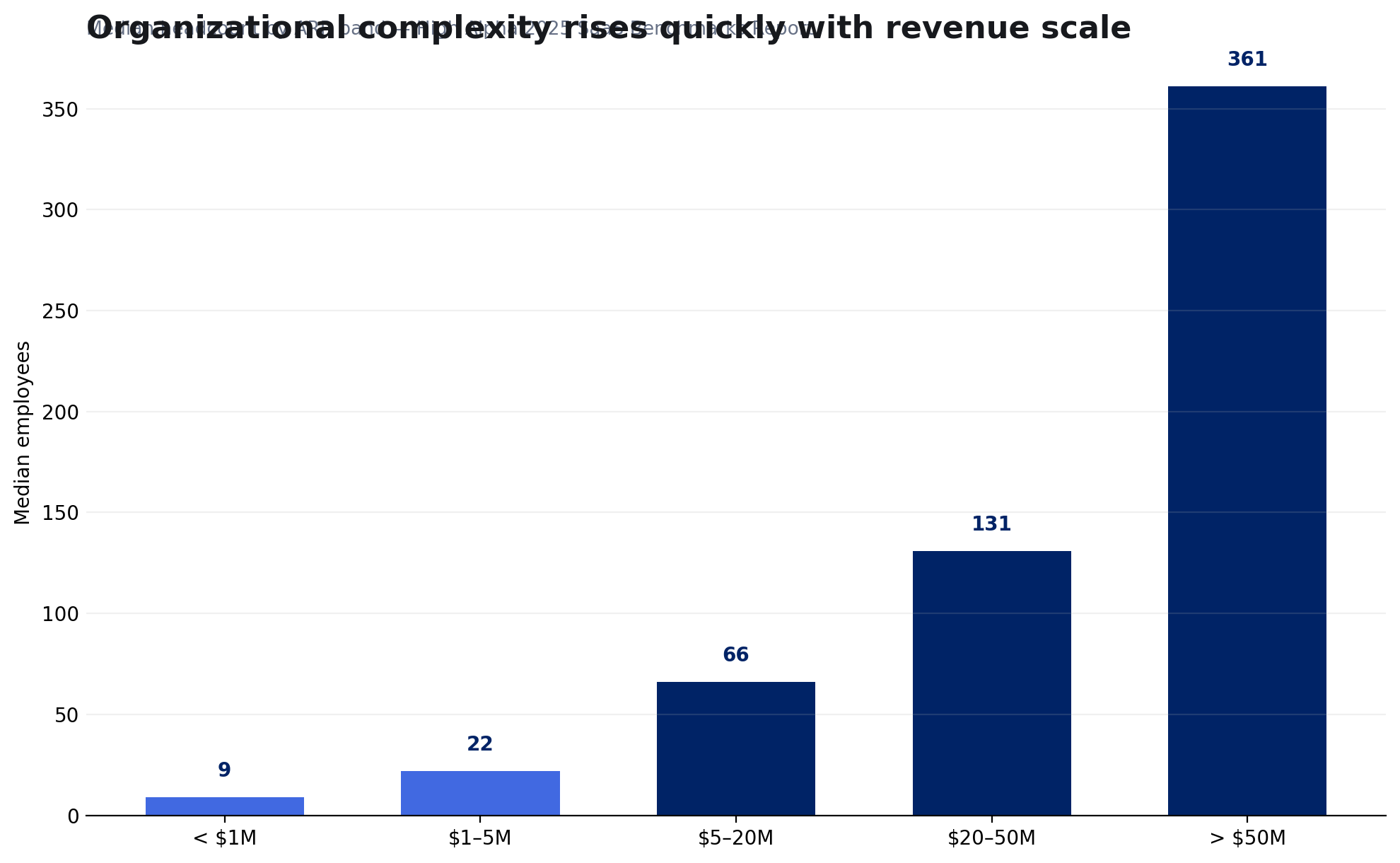
Figure 1. Median employee count by ARR stage. Source: High Alpha 2025 SaaS Benchmarks Report. Woldmark visualization.
1. Direct observation is a real management system — until it is not
At very small scale, the founder often serves as the integration layer of the company. Information does not need to travel far. Product trade-offs, customer complaints, hiring decisions, pipeline quality, and cash pressure can all reach the same person with little formal structure.
This can be an advantage. Formal systems introduced too early can create ceremony without improving decisions. But as specialized functions emerge, the founder stops seeing the underlying work directly and starts seeing selected representations of it: a finance pack, pipeline review, customer-success update, product roadmap, hiring plan, or leadership summary.
The information is not necessarily wrong. The risk is that each representation is optimized for its own function. The founder must still reconstruct the whole business from several partial views.
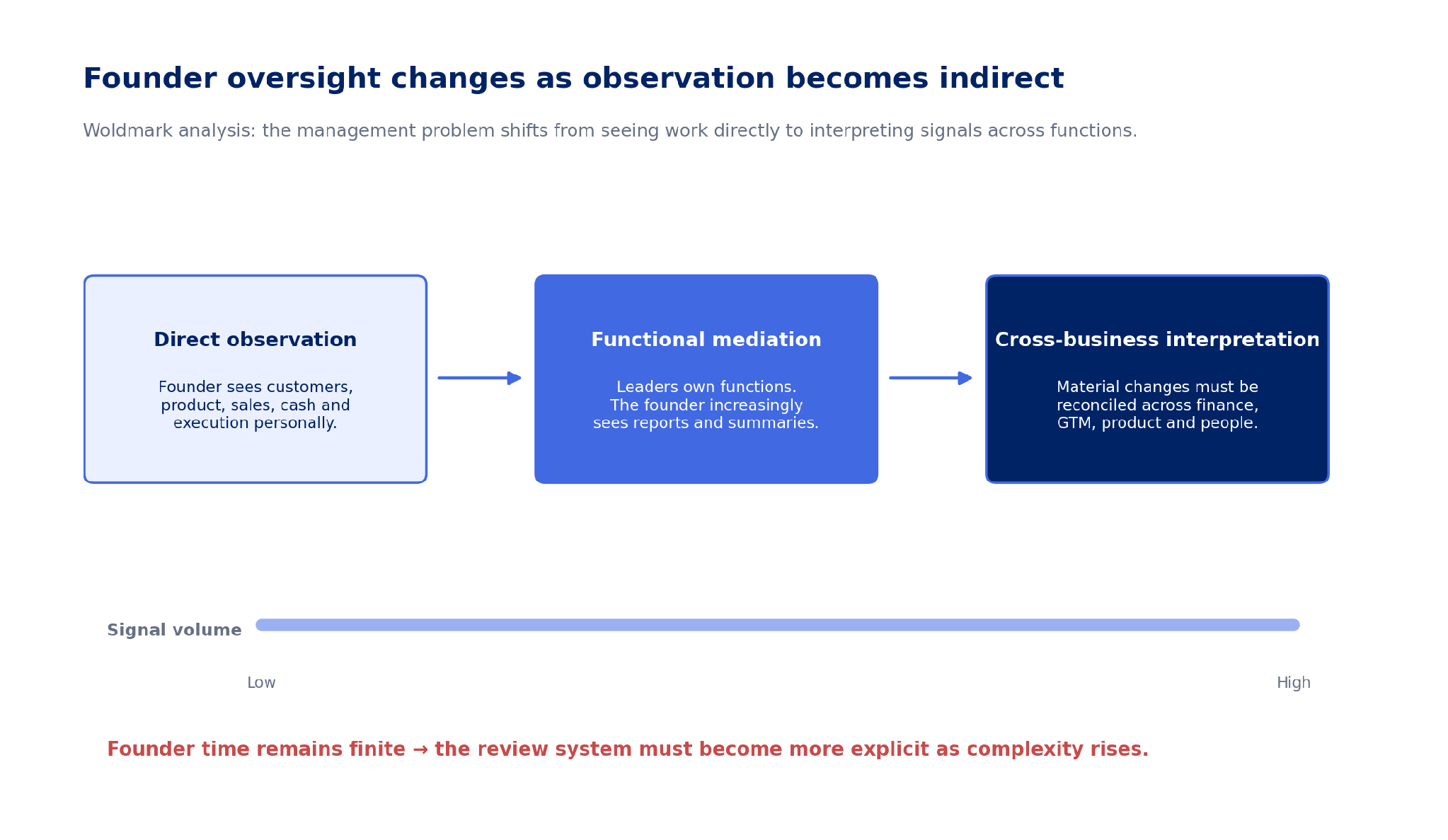
Figure 2. Founder oversight transition. Woldmark analysis.
2. The scaling problem is not simply “too many direct reports”
Management advice often reduces organizational scale to span of control. That is useful but incomplete. McKinsey’s work on managerial spans explicitly rejects a single universal number of direct reports; the appropriate span depends on the nature of the manager’s work, process standardization, work variety, and the skill and independence of the team. Their archetypes range from roughly three to five direct reports for player-coach roles to more than 15 for highly standardized supervisory roles. [4]
This matters for founder-CEOs because their role is usually the least standardized managerial role in the company. They combine strategy, capital allocation, senior hiring, product judgment, customer context, and exception handling. Counting direct reports alone therefore understates the cognitive load.
A founder with seven functional leaders may face more interpretive complexity than a frontline manager with fifteen similar reports because the work is heterogeneous and the decisions are interconnected.
3. Functional leadership solves one problem and creates another
Hiring strong functional leaders is the correct response to complexity. It moves decisions closer to expertise and prevents the founder from remaining the operating bottleneck.
But delegation changes the founder’s information environment. The sales leader sees pipeline quality. Finance sees margin, burn, and cash. Customer success sees churn and implementation friction. Product sees roadmap pressure and usage. People leaders see hiring quality and organizational strain.
Each function can be well managed and still produce an incomplete whole-company interpretation. A weaker sales conversion rate may be explained by pipeline quality, pricing, product fit, customer segment, onboarding friction, or a combination. No single functional report is responsible for reconciling all of those explanations.
That is the point where the founder needs more than good functional reporting: the company needs a reliable way to compare signals across functions.
4. Formal management systems are not the same as bureaucracy
The strongest evidence against the “systems kill startups” intuition comes from research on young high-growth companies. Davila, Foster, and Jia found that management systems can act as an accelerator rather than a brake, and that firms adopting structured systems were associated with faster growth and larger scale. [1]
Their research does not imply that every startup should install heavy corporate processes. It supports a narrower point: once growth creates coordination demands, relying exclusively on personal founder oversight becomes less sustainable.
Broader management research reaches a similar conclusion at much larger scale. World Management Survey work across thousands of firms finds that structured practices around monitoring, targets, and operations are strongly associated with productivity, profitability, growth, and survival. [5]
The useful distinction is therefore not informal versus formal. It is whether the management system improves information quality and decision-making enough to justify its cost.
5. The founder’s information problem changes before the governance structure does
Many founder-led companies do not yet have an active independent board, especially if they are bootstrapped or lightly funded. That does not mean they lack a governance problem; it means the governance problem is still being handled inside management.
Before a formal board becomes necessary, a company may already need a recurring discipline that asks:
- What materially changed across the business this period? Not what each function reported, but what changed when the reports are read together.
- Which explanations conflict? For example, strong pipeline reported alongside weaker win rates, longer sales cycles, or lower implementation capacity.
- Which assumptions are still supported? Growth plan, hiring model, pricing, customer mix, margin expectations, or product priorities.
- Which issues are temporary versus structural? A one-period variance should not receive the same interpretation as a repeated cross-functional pattern.
- What deserves founder attention now? The purpose is prioritization, not adding another management meeting.
6. There is no universal threshold — but there are observable triggers
The Stanford startup research identifies 50–100 employees as a common zone for the transition from personal to professional management systems. [1]
Woldmark would not use that range as a rule. A B2B SaaS company can become difficult to read much earlier if it has several products, customer segments, geographies, or a complex go-to-market motion. Another company can remain relatively simple at a larger headcount.
More useful triggers are behavioral and informational:
- The founder receives more summaries than raw operating context. Important issues increasingly arrive through functional leaders rather than firsthand exposure.
- Functions are individually competent but cross-functional explanations remain unresolved. The same business change produces different narratives in finance, GTM, product, and customer teams.
- Recurring questions survive multiple operating meetings. The company is reporting activity but not resolving interpretation.
- Major decisions require evidence from several functions. Senior hiring, pricing, GTM investment, product expansion, and cost commitments can no longer be evaluated inside one function.
- The founder is repeatedly surprised by information that existed somewhere in the company. The failure is increasingly synthesis, not data availability.
7. What a cross-business review should do — and what it should not
| Should do | Should not become |
| Compare material changes across finance, GTM, customer, product, and organization | A second operating dashboard |
| Separate observed facts, management explanations, and unresolved hypotheses | A forum where every function defends its plan |
| Track assumptions and contradictions across periods | A monthly strategy offsite |
| Prioritize a small number of issues for founder attention | An exhaustive catalog of every variance |
| Preserve uncertainty when evidence is incomplete | A score that creates false precision |
| Create continuity from one review period to the next | A substitute for functional accountability |
A practical founder test
| If the founder stopped attending functional meetings for one month, would there still be a reliable mechanism that explains what materially changed across the business, which assumptions weakened, where the evidence conflicts, and what deserves attention next? |
If the answer is no, the company may not have an information shortage. It may have outgrown informal founder oversight.
Evidence Notes
This analysis combines startup-specific research, broad management research, SaaS benchmark data, and Woldmark interpretation. The Davila-Foster-Jia research provides direct evidence that formal management systems can support high-growth startups and identifies 50–100 employees as a common transition zone, but it does not establish a universal threshold for SaaS companies. High Alpha headcount figures are cross-sectional benchmarks and are used only to illustrate how organizational scale changes across ARR cohorts. McKinsey span-of-control ranges are managerial archetypes, not founder-specific prescriptions. Woldmark’s founder-oversight transition, trigger list, and cross-business review design are analytical constructs developed for this publication.
Sources & References
- Stanford Graduate School of Business — Building Sustainable High Growth Startup Companies: Management Systems as an Accelerator — Source
- Harvard Business School — Scaling a Startup: People and Organizational Issues — Source
- High Alpha — 2025 SaaS Benchmarks Report — Source
- McKinsey & Company — How to Identify the Right Spans of Control for Your Organization — Source
- NBER — Measuring and Explaining Management Practices Across Firms and Countries — Source
- NBER — The World Management Survey at 18: Lessons and the Way Forward — Source
About Woldmark
Woldmark is an independent intelligence firm for founder-led companies. We publish research and analysis and provide recurring independent business performance reviews focused on material change, key assumptions, performance interpretation, and emerging risk. woldmark.com · vitaly@woldmark.com